CS Students Receive Grant Family and Ben Shneiderman Awards
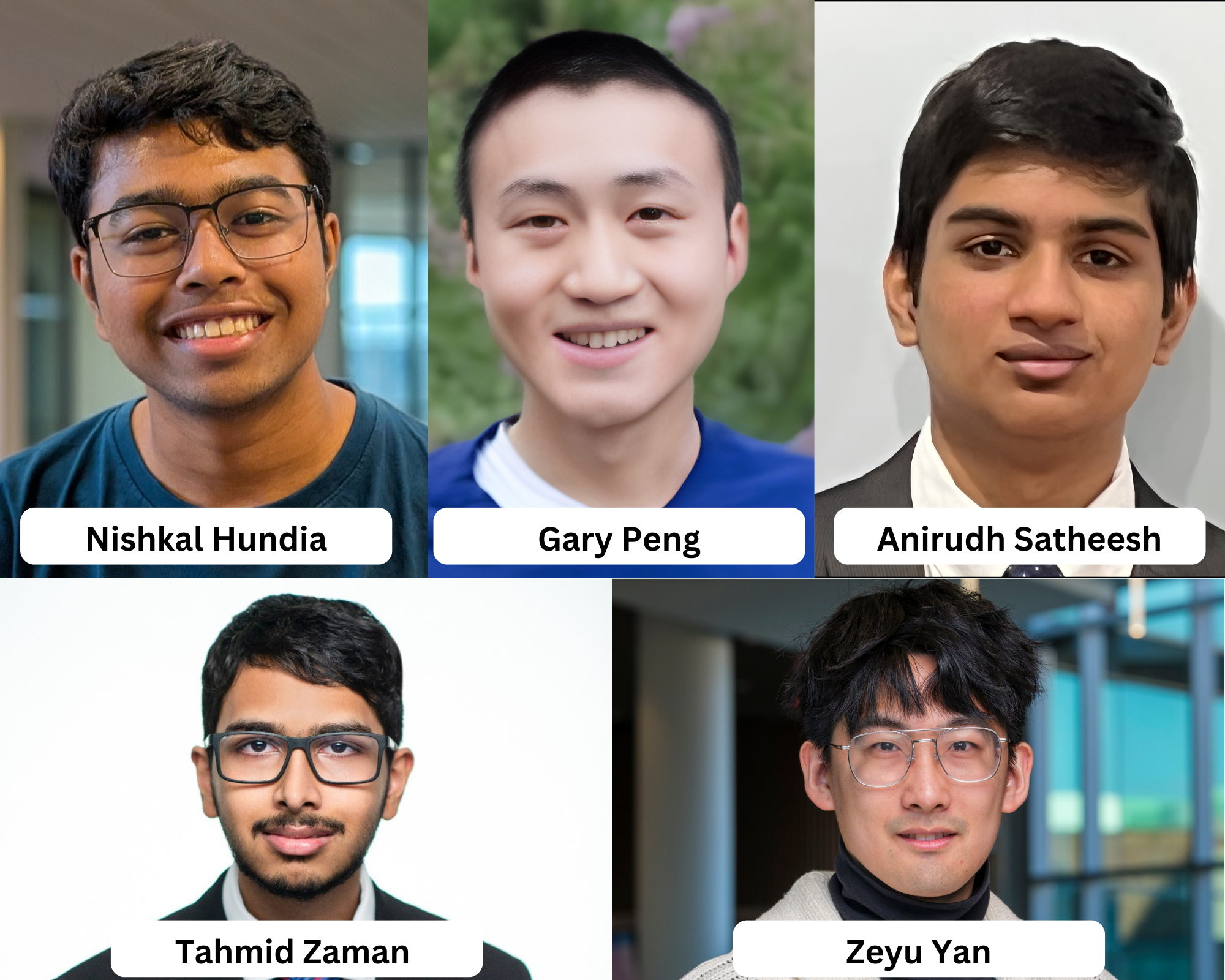
The University of Maryland’s Department of Computer Science recognized four undergraduate students and one doctoral student with awards honoring work across computer science, mathematics and human-computer interaction.
Recent computer science and mathematics majors Nishkal Hundia (B.S. '26, computer science; mathematics), Gary Peng (B.S. '26, computer science; mathematics), Anirudh Satheesh (B.S. '26, computer science; mathematics) and Tahmid Zaman (B.S. '26, computer science; mathematics) received the Grant Family Outstanding Achievement Undergraduate Student Award in Computer Science and Mathematics. Computer science Ph.D. student Zeyu Yan (Ph.D. ’26, computer science) received the Ben Shneiderman Outstanding Thesis Award in Human-Computer Interaction.
The Grant Family Award, established by Adjunct Professor of Computer Science John Grant, recognizes graduating seniors who pursue double majors in computer science and mathematics. Grant has been a faculty member in both the mathematics and computer science departments for more than 50 years.
The Ben Shneiderman Outstanding Thesis Award in Human-Computer Interaction, named after Professor Emeritus Ben Shneiderman, recognizes research contributions by a master’s or doctoral student whose thesis advances the theory or practice of HCI.
About the Award Recipients
Nishkal Hundia
Hundia began his undergraduate studies as a computer science major, but his interest in artificial intelligence and language models led him to study mathematics alongside it. He said the decision reflected his interest in understanding the mathematical ideas that support many areas of computer science.
“So much of what makes computer science powerful is really a wrapper around core mathematical concepts, and I wanted to understand those ideas at their roots rather than just work with the abstractions on top,” Hundia said.
That perspective shaped how Hundia thinks about emerging areas of research, particularly as AI becomes more visible across scientific fields. He said the technical progress behind those systems is often discussed in broad terms, even though much of the work depends on mathematical reasoning.
For Hundia, studying both disciplines also gave him a way to connect theory with the systems being built around it.
“I’m incredibly honored to receive this award and deeply grateful to everyone who supported me throughout my undergraduate journey,” Hundia said. “Beyond the personal recognition, it feels like a validation of something I believe strongly: that computer science is best understood when studied alongside the mathematics that underlies it, and I’m glad that’s something worth celebrating.”
Anirudh Satheesh
Satheesh was first drawn to computer science through an interest in building practical applications that could solve real-world problems. His coursework later led him to pursue a deeper mathematical understanding of the systems and algorithms behind those applications.
Satheesh said mathematics and computer science will continue to shape research in connected ways. He said mathematics can help define the limits of what is possible, while computer science can help determine what can be implemented at scale. He pointed to artificial intelligence, quantum computing and other computational sciences as areas where both disciplines will remain important.
Receiving the Grant Family Award, Satheesh said he recognized the value of pursuing both fields together.
“It is especially meaningful because it recognizes the value of pursuing both computer science and mathematics together,” Satheesh said. “I am grateful to the faculty, mentors and peers who supported me throughout my time at UMD. The award motivates me to continue pursuing research at the intersection of these disciplines.”
Tahmid Zaman
Zaman’s path into computer science began with programming and the possibility of using software to build tools with relatively few barriers to entry. Mathematics offered a different but related appeal, giving him a way to understand patterns, systems and natural phenomena with precision.
“I had always been interested in programming: the idea that anyone could leverage computers to build something impactful was something that I could be passionate about when I entered university,” Zaman said. “At the same time, I always appreciated how math precisely describes the natural phenomenon and dynamics of our world, and how even the most complex mathematical abstractions have some real-world application.”
The connection between the two fields became a defining part of his academic path. For Zaman, computer science offered tools for building and testing ideas, while mathematics provided the language for understanding the structures behind them.
“The intersection between these fields made it an obvious choice to study both,” he said.
Zaman said the relationship between computer science and mathematics is becoming increasingly visible in scientific research, particularly in areas that rely on large datasets, predictive models and advanced computing systems. He pointed to protein structure prediction, quantum computing, post-quantum cryptography and AI-assisted formal verification as examples of areas shaped by both disciplines.
As he prepares to move beyond his undergraduate studies, Zaman said the award came at a meaningful point in his academic path.
“I am truly grateful to receive the award, and especially thankful to UMD’s professors, clubs and other resources that supported me on my journey,” Zaman said. “It inspires me to apply the knowledge and experiences I’ve gained as I begin my career.”
Zeyu Yan
Yan, advised by Assistant Professor of Computer Science Huaishu Peng, received the Ben Shneiderman Outstanding Thesis Award in Human-Computer Interaction for research examining how computation can be integrated into the physical world. His work centers on HCI, with an emphasis on how computational methods can shape materials, artifacts and creative processes.
“My research sits at the intersection of computation and the physical world,” Yan said. “I have always enjoyed building things, and over time I became fascinated by how computation can be embedded into the processes, materials and artifacts we create.”
In Yan’s view, computation can change the pace and scope of research by helping researchers model systems, test ideas and refine designs before moving into more resource-intensive stages of experimentation. For work that crosses disciplines, those tools can make it possible to explore problems that do not fit neatly within one field.
Receiving the Shneiderman award, Yan said, was meaningful not only as recognition of his thesis work but also as support for research that crosses academic boundaries.
“I feel incredibly honored and grateful,” Yan said. “Beyond the recognition itself, I deeply appreciate Ben and the broader community for investing their time and resources in supporting researchers who work across disciplinary boundaries.”
Yan said interdisciplinary research can sometimes fall between traditional fields, making recognition from the HCI community especially significant. To him, the award also reflects the role computer science can play in connecting technical research with other domains.
—Story by Samuel Malede Zewdu, CS Communications
The Department welcomes comments, suggestions and corrections. Send email to editor [-at-] cs [dot] umd [dot] edu.