Mokhtarzada Hatchery Showcased Student Startups at Fifth Annual Demo Day
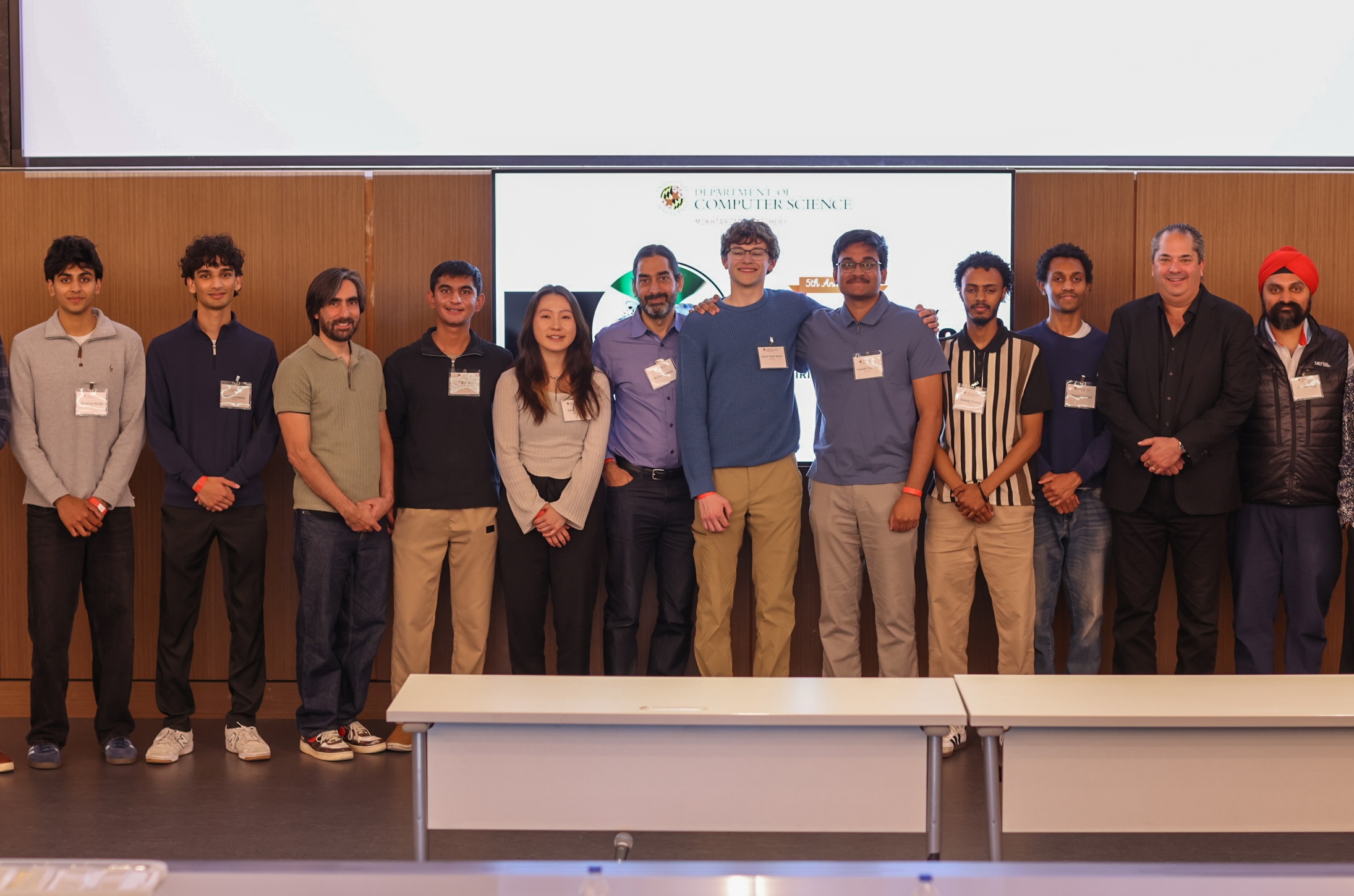
University of Maryland students and recent alumni developing startups through the Mokhtarzada Hatchery program presented their work on May 4, 2026, during the initiative’s fifth annual Demo Day.
Established in 2021 by UMD alumni Haroon Mokhtarzada (B.A. ’01, economics), Idris Mokhtarzada (B.S. ’10, computer science) and Zeki Mokhtarzada (B.S. ’01, computer science), the Hatchery supports early-stage student ventures with funding, guidance and workspace in the Brendan Iribe Center for Computer Science and Engineering. The program selects up to four teams each year and provides mentorship from alumni, founders and experienced startup leaders.
This year’s teams, Capy’s Journey, Cube, SenseGuard and ThinkEx, presented products that support mindfulness practices for children, group-based savings, monitoring vacant properties and organizing AI-assisted research.
Zeki Mokhtarzada said the event gave mentors a chance to reflect on the student founders’ progress over the past academic year.
 “We continue to be surprised by the quality of the teams, the quick adoption of new technologies and new tools from these students,” Zeki said. “They are learning about computer science, but at the same time keeping up with the latest trends and oftentimes teaching us new techniques as they are picking them up.”
Zeki also shared that the same pace of experimentation is central to what students should expect from the program.
“With today’s AI tools, there’s no excuse not to prototype and build an application, even if it just starts as a quick idea,” he said. “If you have an idea and you want to obsess over it, you should join the Hatchery.”
Capy’s Journey
 Led by UMD undergraduates Olivia Zhang (B.S. ’27, computer science) and Rohan Vyas (B.S. ’28, neuroscience), along with Cornell University student Caleb Shim (B.S. ’28, computer science; B.S. ’28, mathematics), Capy’s Journey is a gamified mobile app focused on mindfulness and attention training for children. The app offers guided meditations, lessons and daily wellness exercises designed to help users build regular mindfulness practices through an interactive format.
“Capy’s Journey is important because it delivers the validated tool of mindfulness meditation to kids in a way that feels approachable and fun,” Zhang said. “We keep kids engaged through guided meditations and wellness activities that are tailored to a child’s age, and we reward them with ways to customize their capybara and earn achievements.”
The app launched on the App Store in the spring, and the team is working to grow its user base. Zhang said the team is also developing a professional dashboard that could support future partnerships with clinics, hospitals, schools and other institutions.
Zhang credited the Hatchery program with helping the team narrow its target audience and make product decisions earlier in the process.
Cube
 First envisioned by UMD alum Fitsum Endashaw (B.S. ’19, computer science), Cube is a digital savings platform that allows people to pool money in groups and take turns receiving a lump-sum payout. The startup is now being carried forward by Robel Endashaw (B.S. ’25, computer science) and Abubakr Hussien (B.S. ’26, computer science). The platform is designed to give members access to funds without interest or traditional debt.
“Cube is rebuilding how people access money by helping trusted groups pool funds together in a simple and reliable system,” Robel said. “What Cube does well is help people access larger amounts of money sooner without taking on the burden of traditional debt.”
The platform has more than 50 active users across more than 12 savings groups, according to the team. Cube recently launched its beta and is focused on improving the product experience, automating contribution processes and growing through community adoption.
Robel said the Hatchery helped the team test with users earlier and think more directly about product development and growth.
SenseGuard
 Developed by Edward Marine (B.S. ’27, computer science) and Viswanath Vasa (B.S. ’27, computer science; B.S. ’27, mathematics), SenseGuard provides a monitoring system for vacant sites, including real estate assets. The system uses LoRaWAN, a wireless communication protocol, to connect sensors across properties while using less power and lower-cost infrastructure than some Wi-Fi or Z-Wave alternatives. Its platform includes sensor installation, a web dashboard and automated email alerts.
“Property damage from water leaks and HVAC failures costs managers over $10 billion per year, yet over 95% of buildings have no real-time monitoring,” Vasa said. “We deploy long-range IoT sensor networks in buildings to detect failures in real time before they become major damages.”
SenseGuard has an active pilot with its design partner, the Archdiocese of Baltimore, and has begun developing and manufacturing sensors in-house. The team is also working on a second version of its sensors and an initial version of its gateways.
Vasa said the Mokhtarzada Hatchery Program’s structure helped the team move from an early prototype toward a more complete system.
ThinkEx
 Led by UMD students Ishaan Chakraborty (B.S. ’27, computer science) and Urjit Chakraborty (B.S. ’29, computer science), ThinkEx is a digital environment designed to capture and organize user interactions with large language models. Instead of leaving information scattered across chat threads, the platform turns questions, notes and insights into persistent cards that are grouped into clusters.
“ThinkEx fixes this with a collaborative workspace where your files, documents and media live directly alongside the AI, so every answer is grounded in your actual materials, not just the open internet,” Urjit Chakraborty said.
ThinkEx is live, and the team said its daily active user base has grown from 50 to more than 200 users over several months. The team is focused on product development, user feedback, marketing and potential accelerator applications.
Urjit credited the Hatchery with helping the team focus on users and feedback during an early stage of development.
—Story by Samuel Malede Zewdu, CS Communications
The Department welcomes comments, suggestions and corrections. Send email to editor [-at-] cs [dot] umd [dot] edu.